

Why the Grocery Code of Conduct Won’t Lower Prices and What It Shows About Industry Self-Regulation
Canada’s first grocery code of conduct likely won’t lower prices but it offers a useful illustration of the limits of industry self-regulation.
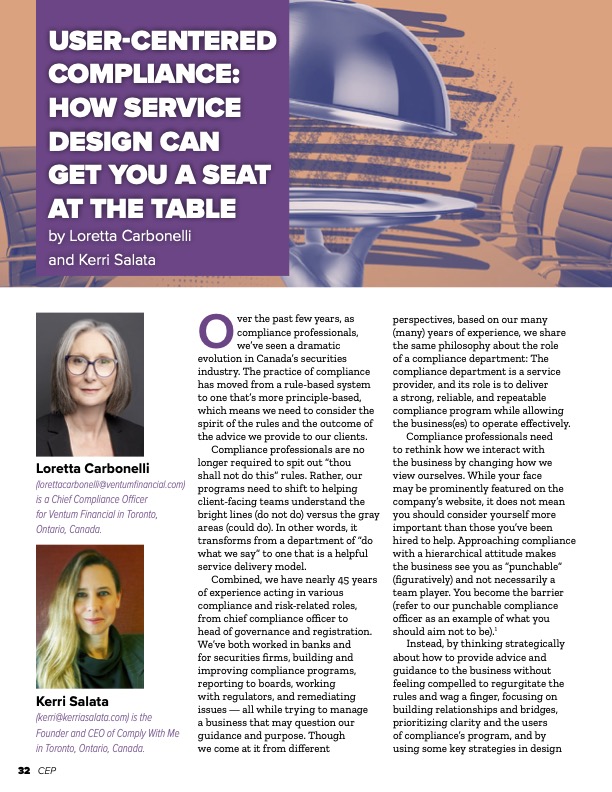
This Fall, I had the incredible opportunity to lecture at a three-part Innovation Masterclass workshop with Ontario Lottery and Gaming Corporation (OLG), introducing a group of Legal, Compliance, Governance and AML professionals to design thinking. As someone who practices legal design and applies these principles in compliance and the law, my goal was to show
How luck am I? I got to start off my morning speaking with Legal Design great, Hannele Korhonen. Even though it was the morning in Ontario (the afternoon for Hannele in Finland), our discussion about Legal Design and how it can be effectively used in regulatory Compliance was anything but a “snoozefest”. Check out
What can behavioural economics teach us about legal design?
Behavioural Economics and Legal Design: Choice Architecture Read More »
In July 2021, the CSA published Notice of Amendments to NI 31-103 and the Companion Policy entitled Registration Requirements, Exemptions and Ongoing Registrant Obligations to Enhance Protection of Older and Vulnerable Clients. These amendments were adopted by IIROC and the MFDA (jointly CIRO). This is an excerpt from a 30+ minute Compliance Training video created
https://vimeo.com/713449767?share=copy
CSA’s Client Focused Reforms on Suitability, Know-Your-Client, Know-Your-Product – How these Regulatory Obligations “Fit” Together.
Reinvent your policies, procedures & governance documentation
Policies, Procedures & Forms – Old School versus the New School Method Read More »
Consumers should be cautious of celebrity endorsements when choosing a FinTech
FinTechs and Celebrity Endorsements – Do Consumers Need More Clarity? Read More »
In my earlier blog, I introduced readers to the concept of Legal Design and arguing that there is no one-size-fits-all definition. We also talked about three potential applications of the Design Thinking methodology in the approach to Legal Design (1. Document and Policy Design – the layout, the plain language; 2. Service Design – re-designing something