




I’ve said it before and I’ll say it again. Legal design is not just “lipstick on a pig”. It has real, practical uses in the law, and particularly in litigation. In my previous blog, I explored some uses for Legal Design that included “Documentation and Policy Design”, also called “Informational Design” but with a legal twist. After attending Luxatia’s 2nd World Legal Design and Information Summit hosted in Berlin, Germany, I watched a Senior Information Designer at a Netherlands Law Firm explain how she used Legal Design to truly “tip the scales” in favour of her firm’s Client in a litigation matter. Our Firm is also in the process of using a visual aid (a curated video) in support of an ongoing litigation matter at the mediation stage, but the results are yet to be determined. I will use this time to discuss Dutch case study and how informational design could impact the outcome of litigation.

At the Luxatia Conference, the Netherlands Law Firm discussed a case where the use of an infographic helped settle contentious litigation. According to the speaker, the matter involved a dispute between a Dutch District Water Control Board and a Municipality about property taxes.* The litigation was ongoing for over 8 years, involved multiple levels of the Dutch Courts and saw several appeals. The issues in the matter were important and precedent-setting in that any decision about this waste-water treatment facility would impact similar facilities and impacted the application of municipal taxes. The case eventually settled when one party was faced with the reality that their position had little to no merit. However, that only happened once the Netherlands Law Firm introduced Legal Design to the case.
When the Netherlands Law Firm introduced their infographic to the disputing party and the Judge, it became clear that the water treatment facility could not effectively complete the process without the municipality’s participation. Both parties were ordered by the Judge to come up with a resolution and the matter settled shortly thereafter. Here is a high-level portrayal of the infographic. The images are intentionally blurred, blacked out and made to be unreadable, but just a quick look at the “before” and “after” images has a significant impact and will help you understand the difference.
Before: A typical, run-of-the-mill, basic flow-chart

After: WOW! Infographic-style
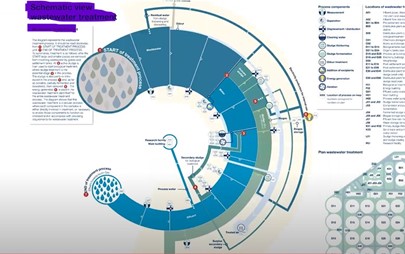
Why does the second image work so well? In basic terms, the information designer takes complex information and distills it into a digestible format for the reader. This is an ‘Infographic’. In “Knowledge is Beautiful”, David McCandless defined the importance of visualized data:
“[u]nderstanding really is the key. When you understand something, you’re able to perceive its structure: its connections, its relationships, its significance relative to anything else. How it fits. You see-feel-intuit the fit. You know it. You know?”
Introduction, Knowledge is Beautiful (2014)
Yes, we know! We don’t even have to read the two images to understand that the presentation and flow of complex ideas helps the reader to ‘get it’. In the case above, the reader is the Judge, but the application of informational design in litigation can be endless. It can:
- Help each party to visually understand the strengths and weaknesses of their case
- Explain complex processes, chronology of events, the connection between parties and participants, etc.
- Be used as a tool to persuade Judges, Arbitrators, Juries, etc.
- Aid in examination and cross-examination of witnesses
Infographics are not the only informational design application. Other visual aids, like video, can also portray complex information. Our Firm is currently using informational design in an ongoing litigation matter. We plan to use a curated video that combines video footage, the most relevant documentation and on-screen narration to support the Mediation Brief and tell the Client’s story to the mediator and the other parties.
So long as the information isn’t being manipulated, distorted or misrepresented, but presented in a manner that distills complex information into a digestible format, the use of visuals in the litigation process can be an effective tool for the litigator because, as McCandless notes, “understanding really is the key”, and in a litigator’s case, understanding may be the key to a successful outcome for your Client.
*For full disclosure, I tried, but was unable to find this case. The summary above is based on the speaker’s presentation and my notes.
This blog is not legal advice.