




Big Bang in Designing Contracts
In the legal design community when we’re discussing legally-designed contracts, we usually speak about the contract being user-friendly and written for the reader. This can mean using plain language, more “white space”, left-justification, potentially an illustrative graphic or two, some colour and BAM! Like an astronomer trying to explain the Big Bang Theory to us non-sciency people, a legally-designed contract is the evolution from a single written contract into something that continues to expand and stretch over time, a concept that can be difficult to explain to traditional legal practitioners. The perfectly designed contract is beautifully composed, illustrative and instructive. Even if the contract is approaching perfection, many legal designers still seek to disrupt – can I just push this a little further? Can it be better? Can it be even more user-friendly? Lieke Beelen, an Industrial Design Engineer and Founder of the start-up Visual Contracts, is seeking to create galaxies of well-designed contracts by mixing together her light and energy to focus on the ‘user journey’ of a contract. In the universe of contracts, let’s explore one particle(rly) interesting employment agreement and explore to what extent the document achieved its purpose.
Some Challenges in Drafting Employment Contracts
There are several challenges when dealing with employment contracts. The most obvious is the power imbalance between employer and employee. While there are two negotiating parties to the contract, one is often a sophisticated corporation with access to legal resources while the other party may have never signed (or seen) an employment contract previously. There is a disparity in negotiating power between the two with one at an obvious disadvantage.
Additional challenges in employment contracts the end-users, the employees, may not be considered during the drafting:
Yet, this type of approach, which is completely focused on protection, hinders the opportunities of the business as their needs are not the main objective (Passera, 2017). A more adequate approach would rather focus on the agreement and well-being and will consider a more flexible relationship between employer and employee (IACCM, 2015). In this way, it will be possible to maximize the opportunities of all stakeholders and pursue a common goal.
Visual Contracts, White Paper, page 11.
How do we overcome the challenges with employment contracts? It might not be as simple as plain language, bright headings and bigger font. The key may be better visuals or mostly visuals and user research – lots of it! Can the employment contract achieve its legal objective if it is drafted to focus on what the disadvantaged signatory needs to know to understand it?
Visual Contracts
Pushing employment contract design to the limits is what Lieke Beelen and her company, Visual Contracts, is seeking to do. According to their White Paper on Visual Contracts, Visual Contracts is a start-up focused on how contracts are designed and used, and how legal content is perceived by focusing specifically on the user’s journey and whether the contact achieves its intended purpose (White Paper, page 5). Visual Contracts redesign of an employment agreement with a Cleaning Company is a wonderful illustrative example of how employment contracts can be reimagined.
Case Study – An Employment Agreement for a Cleaning Company
There is a Cleaning Company who hires cleaners and they need an employment contract. They need to specify what the employees do, when they do it, how much they’ll get paid and when. There may be a temporary employment period. They also have to illustrate what happens when the employee does something that doesn’t meet their corporate standards, like steals from a home they’re cleaning, forgets to lock up when they’re done, breaks things or lets the family indoor cat outside. The day-to-day responsibilities for cleaning and expectations also need to be met to maintain employment.
Many of the employees of the Cleaning Company don’t speak or read the native language well or at all. Some are newcomers to the country and this will be their first job. Many of them rely on friends and relatives as interpreters, and most won’t read the contract at all.
From the employee’s perspective, the conditions of the agreement influence several aspects of their daily lives, such as economic situation, health condition, level of independence, self-development opportunities, social status, etc. In the case of employers, contracts also play a very important role as they define the relationship with the employee and how they protect and capture the interests of the business.
Ibid, page 11.
User-Testing
Visual Contracts follows the design thinking steps (for our definition of legal design, refer to our earlier blog) which means that usability or user-testing is a key element to determine success of any design:
“As explained…current contracts present several difficulties, and these play a very important role in the usability of the contracts…how easy it is for the reader to get access to the contract, find the relevant content and understand the terms. The density of the information and the complexity of the language used are some of the elements that play a big role in this sense.”
(Ibid at page 56).
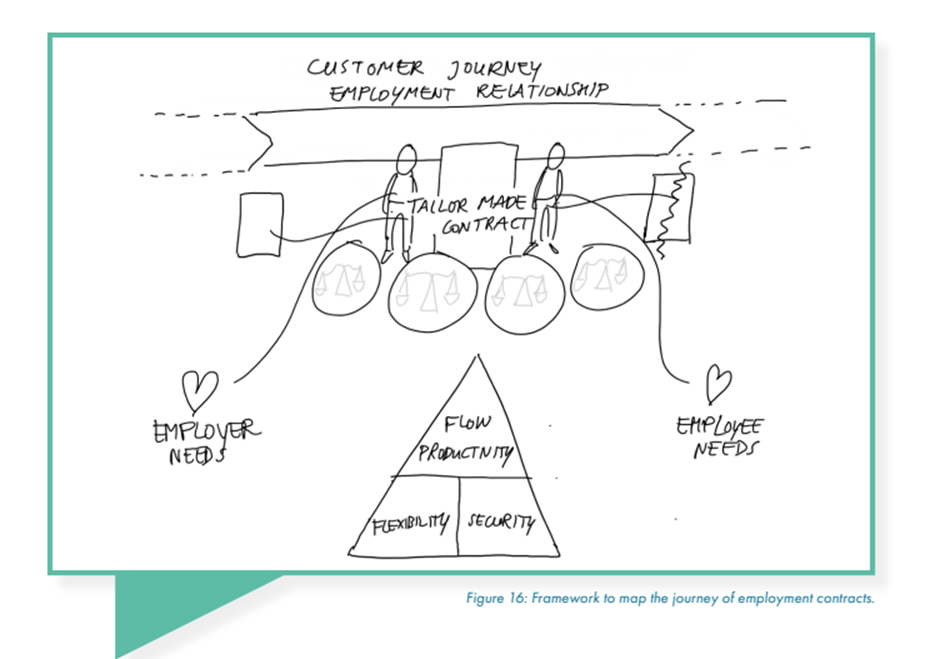
After determining the customer’s journey (i.e. user), Visual Contracts did something that many lawyers forget to do, they focused on testing, prototyping and design research with the user throughout the employment contract development process.
Their research observed a clear communication gap between the corporation and the employees. While the employees were involved in their workers’ unions and understood their collective agreements, they did not feel legally empowered and were unaware of their legal rights, or what to do when problems did arise.
Another key observation is that around 40% of the cleaning company’s employees have issues with reading and writing.

When faced with these specific user-issues, Visual Contracts pushed themselves to design a largely visual contract.
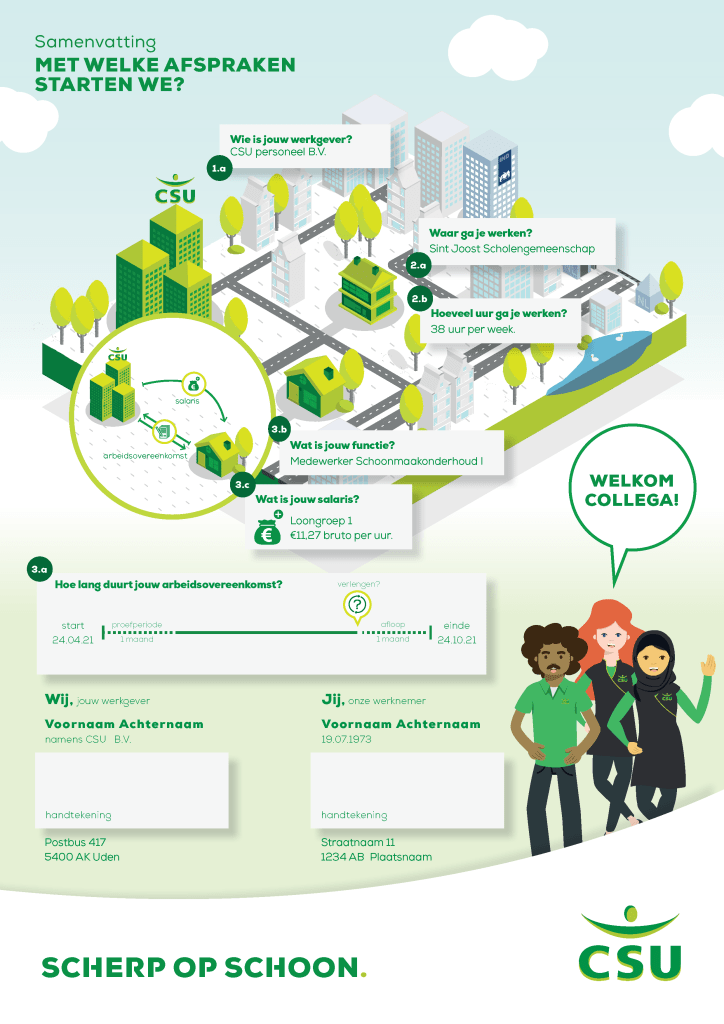
The Contract
If the contract is easier to read, more easily accessible and digestible, it means that it will be more memorable and the reader is more likely to revisit the contract when they’re faced with a difficult situation, like “what happens if I break something while cleaning.”
While this contract isn’t written in English, it’s easy to locate the clauses: where the employee works, what they will make an hour, and the start/end date of the contract. The more “important” and higher risk-related clauses, like termination, are dealt with through more specific language within the contract, but even those clauses are highlighted using illustrations.
Will The Big Bang Bust?
While Visual Contracts continually gathers user feedback and aggregates data on the use and completion rates of their visual contracts, ultimately, like creation itself, there are a few unknowns. When it comes to the Canadian jurisdictional context, the Court’s haven’t exactly told us what crosses the line of being “too visual”. Generally, we know that clarity is key and that it is important to avoid ambiguity:
“An employment contract will be ambiguous where the language of the contract is unclear and/or there is more than one reasonable interpretation of the language in the contract.”
James Knight, Employment Contracts (Lexis: December 12, 2023).
When contractual language is unclear, courts may refuse to enforce some or all of the contract or extrapolate an interpretation that the parties never intended.
Among the various tools Courts can use to interpret contractual clauses, several contract cases recently heard in the Supreme Court of Canada confirm that: “Courts are directed to read the contract as a whole, giving the words used their ordinary and grammatical meaning consistent with the surrounding circumstances known to the parties at the time of the formation of the contract” (Sattva Capital Corp. v. Creston Moly Corp., 2014 SCC 53; Corner Brook (City) v Bailey, [2021] SCJ No 29).When contract drafting, it is important to demonstrate “express intent by the parties” and maintain the client’s legal rights through the proper use of language (Sylvie Gregoire, Plain Language in the Legal Department (Lexis: March 30, 2023)).
While lacking clarity can mean a losing argument, there are some clauses that are low risk. When you examine this visual contract design, the applicable jurisdiction, salary, length of the contract, and who the contract applies to is clear, it doesn’t require additional interpretation or complex legalese. This simplification/clarity is particularly important to someone who may have difficulty reading or understanding a traditional contract because of issues like illiteracy or language barriers. Afterall, this contract was designed based on what the employees told their employer they wanted to see in an employment contract.
Will a contract that pushes the limits of its creation withstand litigation and judicial judgment (in Canadian jurisdictions), or will it crumble because of its illustrative nature, sparse wording and visuals? Only time (and the Courts) will tell and, like the Big Bang theory, the legally designed employment contract existing within the contract universe will need to evolve and adapt based on data, and user feedback and needs. This visual contract illustrates how an employment agreement can be thoughtfully re-designed to benefit the employee, not only the lawyer or the employer, and I admire the moxie of its creator.
For more information about Visual Contracts, you can visit them here.
*This blog is not legal advice.